

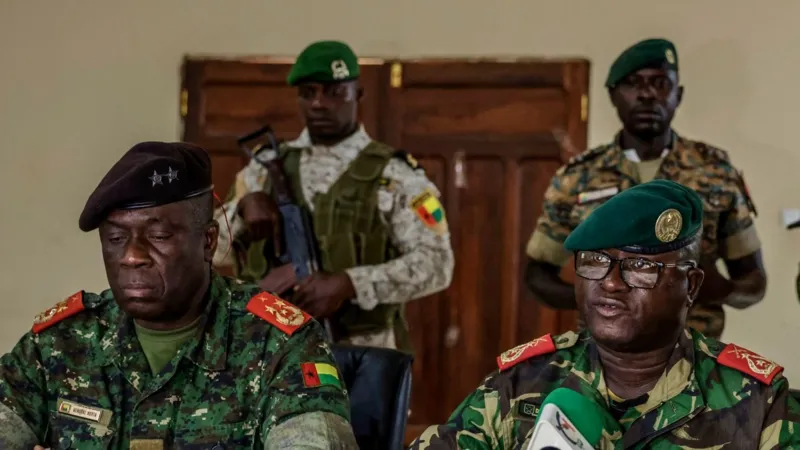
A group of military officers in Guinea-Bissau say they have taken control of the country, with President Umaro Sissoco Embaló reportedly detained following gunfire in the capital, Bissau.
Government sources told the BBC that Embaló was arrested shortly after heavy gunshots were heard near the presidential palace. The officers later appeared on state TV announcing the suspension of the electoral process, days after the nation voted in Sunday’s presidential election.
The military claimed it acted to prevent a plot backed by “a well-known drug baron,” declaring the closure of borders and a night-time curfew. The incident comes as both Embaló and his main challenger, Fernando Dias, had already claimed victory ahead of Thursday’s expected result announcement.
Dias, along with former Prime Minister Domingos Pereira—who had been disqualified from running—was reportedly detained, as well as Interior Minister Botché Candé. Sources also confirmed that army chief Gen Biague Na Ntan and deputy Gen Mamadou Touré were taken into custody by the coup leaders.
Guinea-Bissau, situated between Senegal and Guinea, has a long history of coups and is known as a major drug-trafficking hub. Since independence from Portugal in 1974, the military has remained deeply influential in its politics.
Election observers from the African Union and Ecowas expressed “deep concern,” noting that the vote had been peaceful and both top candidates had pledged to respect the results. They criticised the coup announcement as it came just after meetings aimed at ensuring a smooth transition.
Witnesses reported panic in Bissau as shots were fired around 13:00 GMT, prompting residents to flee for safety. Hours later, General Denis N’Canha read a statement on state TV announcing the formation of the “High Military Command for the Restoration of Order” and urged citizens to remain calm.
Checkpoints have been set up across the city, now under curfew from 19:00 GMT. Portugal, the former colonial power, has called for a swift return to constitutional order.
President Embaló, elected in December 2019, has previously claimed to survive multiple coup attempts, though critics say he used such claims to suppress dissent. His legitimacy had been challenged after he initially refused to seek a second term but later changed course. Opposition groups argue his mandate ended in February 2025.
With a population of just over two million, Guinea-Bissau remains one of the world’s poorest nations. Its uninhabited coastal islands have long made it a key transit point for cocaine smuggled from Latin America to Europe—earning it the UN label of a “narco-state.”
For more Africa news, updates and analysis, follow BBC Africa on Twitter, Facebook and Instagram.
