

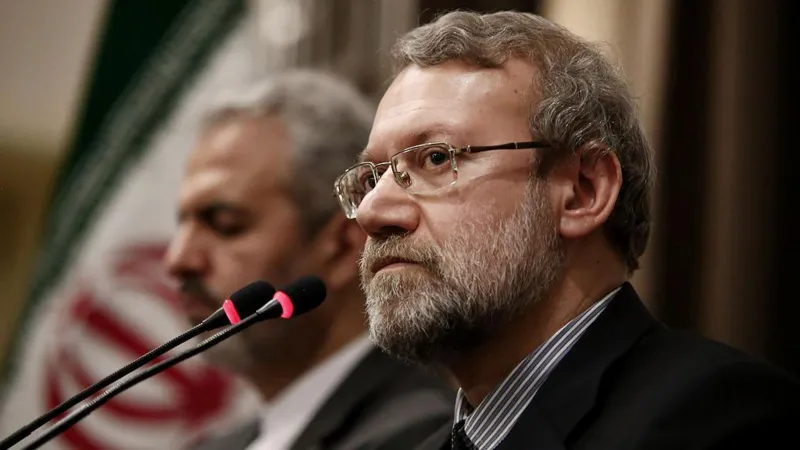
The Israeli air strike that killed Ali Larijani has taken out one of the most capable and strategically significant figures in Iran’s leadership — and state media has now confirmed his death, alongside that of another senior official, Gholamreza Soleimani.
Larijani wasn’t a military commander in the traditional sense, but his influence ran deep. As secretary of the Supreme National Security Council, he sat at the centre of Iran’s most consequential decisions — on war, on diplomacy, on national security. His voice carried particular weight when it came to managing Iran’s confrontation with the United States and Israel. After Supreme Leader Ali Khamenei was killed in the first wave of US-Israeli strikes on 28 February, it was Larijani who set the tone publicly, signalling that Iran was in this for the long haul.
Within Iran he was known as a pragmatist — not a moderate, but someone who paired ideological commitment with a hard-headed, calculated approach to strategy. He was deeply sceptical of the West, yet it was Larijani who served as an envoy in negotiating Iran’s long-term cooperation agreement with China. He favoured moves that made strategic sense over empty posturing, which made him genuinely valuable to the system in ways that pure hardliners rarely are.
At the time of his death, he was simultaneously managing three enormous crises. The first was the war itself — he had argued strongly that Iran should dig in for a prolonged conflict, expanding pressure across the region and maintaining the closure of the Strait of Hormuz. The second was a wave of domestic unrest that had started as economic protest and grown into something far more threatening, with widespread demonstrations demanding an end to the Islamic Republic. The crackdown has already killed thousands. The third was Iran’s nuclear programme and the collapsed indirect negotiations with Washington, both already disrupted by the strikes.
All three of those crises now fall to an unnamed successor stepping into an extraordinarily exposed position. Iran has shown a degree of resilience — partly through its ability to disrupt global energy markets — but its airspace remains open to continued strikes, and whoever steps into Larijani’s role will face the same risk of being targeted from day one.
His death is likely to push power further toward the military. President Masoud Pezeshkian has already indicated that armed forces units have been given broad authority to act if senior leadership is incapacitated — which in practice means faster decisions, but with less central coordination and strategic coherence.
There are also signs that the regime is struggling with succession more broadly. Public announcements have been delayed, and certain key figures — including new supreme leader Mojtaba Khamenei — have been kept largely out of sight. Whether that reflects genuine security precautions or internal disarray is difficult to say.
What is clear is where things are heading in the near term: a harder military posture in the war and harsher repression of dissent at home. Over a longer stretch, a leadership that keeps losing senior figures will find it increasingly difficult to hold together — particularly while governing a country of more than 90 million people facing war, economic collapse and internal revolt at the same time.
Larijani’s death is not simply the loss of one official. It deepens a leadership crisis that could shape both the outcome of the war and the long-term survival of the Iranian state itself.
