

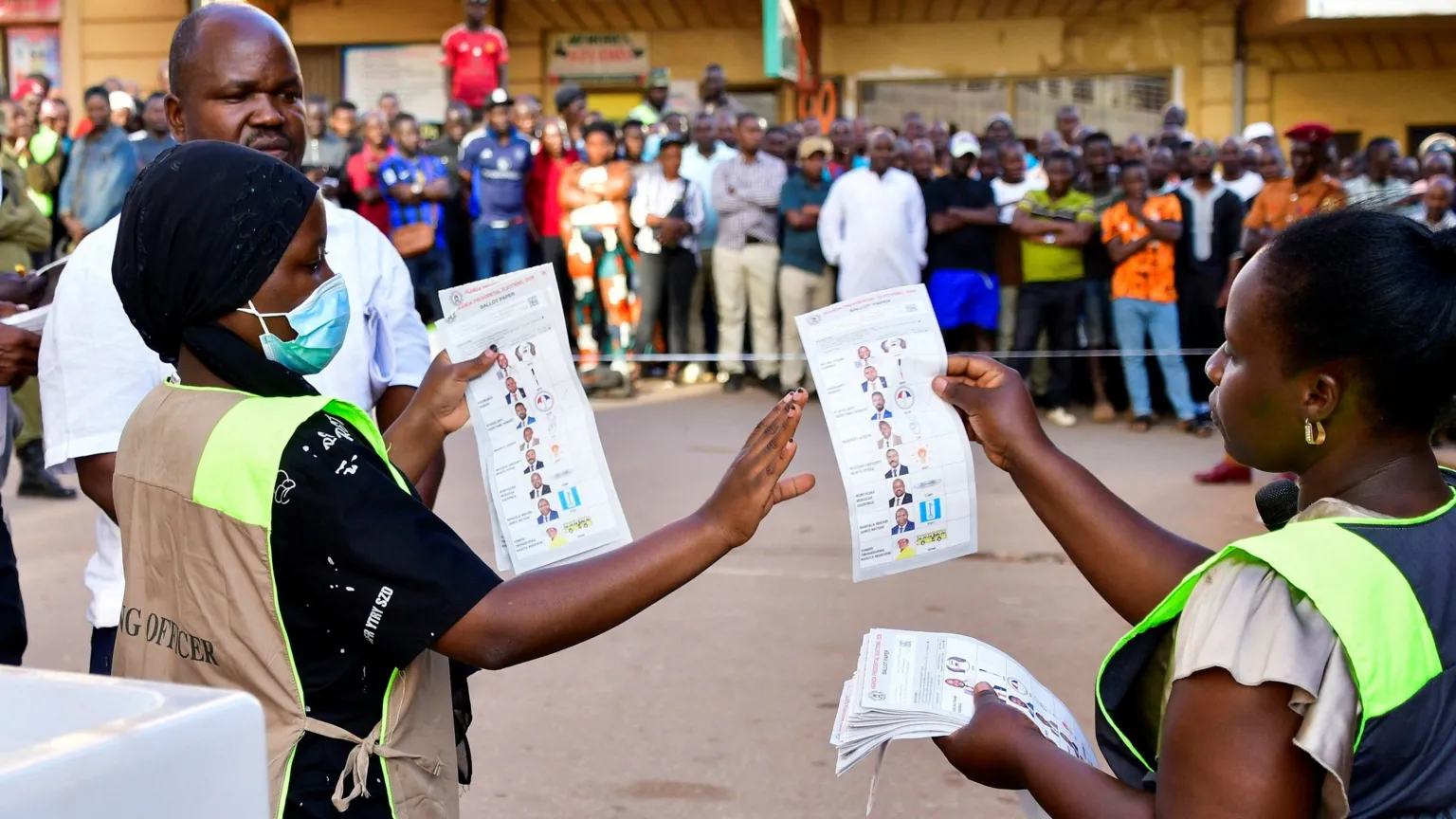
Ballot counting is underway in several parts of Uganda following presidential and parliamentary elections held amid an internet shutdown and allegations of electoral manipulation by the opposition.
Opposition presidential candidate Bobi Wine alleged widespread fraud, claiming on social media that there had been “massive ballot stuffing everywhere,” though he did not provide documented evidence to support the accusation.
Authorities have yet to respond to these claims or to Wine’s assertion that numerous polling agents and supervisors affiliated with his National Unity Platform (NUP) party were abducted or forced out of polling centres.
Voting across the country was disrupted by long delays, with some voters waiting as long as four hours to cast their ballots. These delays were largely attributed to malfunctioning biometric machines used to confirm voters’ identities.
Some observers have linked the technical issues to the nationwide internet blackout, shortages of voting materials, and late delivery of equipment to polling stations. As a result, many polling units remained open beyond the scheduled closing time.
Uganda’s Electoral Commission stated that all voters who were in line by 17:00 local time (14:00 GMT) were allowed to vote. Earlier, the commission issued an apology for what it described as “technical glitches,” assuring the public that efforts were underway to resolve the problems.
The presidential contest is primarily between incumbent President Yoweri Museveni, 81, who has ruled since 1986 and is seeking a seventh consecutive term, and Bobi Wine, a 43-year-old pop star turned politician.
According to the Electoral Commission, the final results of the presidential election are expected to be announced by 16:00 local time (13:00 GMT) on Saturday.
BBC reporters visiting polling stations in Kampala observed that voting concluded by 18:00 local time, despite the earlier delays. Although official turnout figures have not yet been released, the prolonged disruptions suggest that some voters may have left without voting.
Others, however, remained determined. Many expressed frustration at the morning setbacks.
“I’m angry because I haven’t voted yet. We were supposed to start at seven, but by eight nothing had happened. The ballot papers aren’t even here. I don’t know what to say,” said Kaweesi Ismail, a voter in Kampala.
In locations where biometric systems failed, Electoral Commission chairperson Simon Byabakama authorised officials to revert to using the national voters’ register.
The technical challenges appeared to affect both ruling-party strongholds and opposition-leaning areas.
President Museveni, voting in his home village of Rwakitura in western Uganda’s Mbarara region, acknowledged encountering difficulties with the biometric equipment.
“I placed my thumb on the machine and it didn’t accept it. But when it scanned my face, it worked immediately. The machine is functional,” he said.
When asked whether he would accept the election results, Museveni suggested the issues might indicate interference.
“This is one of the manipulations. We must find out what went wrong,” he said, adding that investigations were ongoing to determine whether the problems were deliberate.
Although there are eight presidential candidates in total, analysts say the race is effectively between Museveni and Wine. Given Museveni’s victories in the previous six elections, observers believe he is likely to extend his long hold on power.
Wine has campaigned on promises to combat corruption and introduce wide-ranging reforms, while Museveni argues that his leadership guarantees stability and continued development.
The election campaign was marked by frequent disruptions to opposition activities. Security forces have been accused of harassing, detaining, and assaulting supporters of Bobi Wine.
Police spokesperson Kituuma Rusoke rejected these claims, accusing opposition supporters—particularly those from the NUP—of causing disturbances.
Internet access was suspended nationwide on Tuesday. Uganda’s Communications Commission said the shutdown was necessary to curb misinformation, electoral fraud, and the incitement of violence. However, the move was criticised by the United Nations human rights office, which described it as “deeply worrying.”
The NUP dismissed the government’s justification, accusing authorities of attempting to prevent the opposition from mobilising supporters and sharing evidence of irregularities.
In response, the party introduced an offline vote-monitoring application. The app, known as Bitchat, uses Bluetooth technology to transmit images of polling station results forms and voting data without requiring internet access, according to Wine.
Museveni, a former guerrilla leader, has benefited from constitutional amendments that removed presidential term and age limits, allowing him to continue contesting elections.
Wine—whose real name is Robert Kyagulanyi—also ran against Museveni in the 2021 election but rejected the outcome, alleging widespread fraud.
Alongside choosing a president, Ugandans are also electing a new parliament, with 353 legislative seats contested nationwide.
For many voters, economic concerns dominated their decision-making. While Uganda’s average income has been increasing, job opportunities have not kept pace with population growth. More than half of the population is under 30, and unemployment among young people remains high.
Voters also cited poor infrastructure and unequal access to education and healthcare as pressing national issues.
Human rights organisations, including the United Nations and Amnesty International, reported increasing harassment of opposition supporters during the campaign, including arrests on what they described as politically motivated charges.
Wine’s campaign rallies were frequently disrupted by security forces, in contrast to those of the incumbent.
Amnesty International condemned the actions of the security forces, describing the use of tear gas, pepper spray, physical assaults, and other tactics as part of “a brutal campaign of repression” in the lead-up to the vote.
Additionally, the head of Uganda’s Electoral Commission told the BBC that he had received threats warning him against announcing certain election results.
