

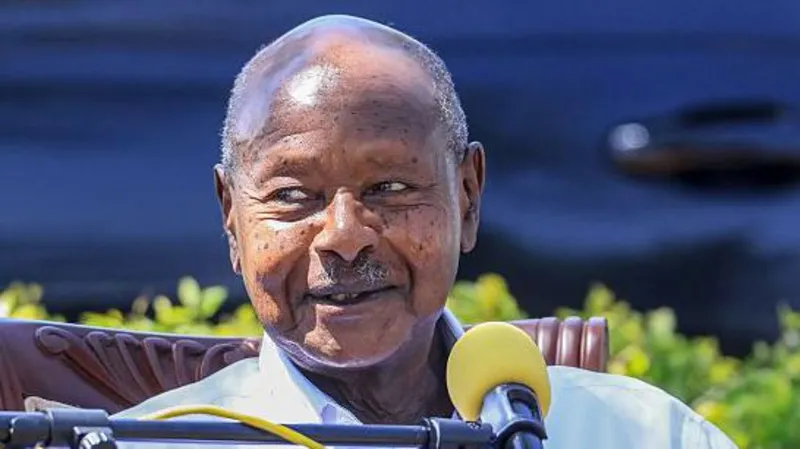
At least seven supporters of Uganda’s opposition were killed overnight under disputed circumstances, as preliminary results from Thursday’s presidential election show President Yoweri Museveni taking a commanding lead.
Opposition figures say the deaths occurred after security forces stormed the home of a member of parliament in Butambala, around 55km south-west of the capital, Kampala. Police, however, have blamed the violence on opposition supporters, saying officers acted in self-defence.
Figures released by the electoral commission on Friday afternoon show Museveni leading with 75% of the vote, based on results from 60% of polling stations. His closest rival, opposition leader Bobi Wine, is reported to have secured 21%.
Wine’s party, the National Unity Platform (NUP), said security forces had surrounded his residence in Kampala, effectively placing him and his wife under house arrest. Journalists attempting to access the area were reportedly blocked.
Because of a nationwide internet shutdown imposed earlier in the week, news of the overnight violence only began to circulate publicly on Friday.
Opposition MP Muwanga Kivumbi told international media that police and soldiers fired tear gas and then live ammunition at crowds gathered at his home to follow early election results.
“Ten people were killed inside my house,” he said.
Human rights activist Agather Atuhaire corroborated this account in statements to news agencies.
Police spokesperson Lydia Tumushabe rejected the opposition’s version of events, stating that officers came under attack from what she described as violent NUP supporters who had targeted a police station and planned to overrun a vote tallying centre. She said the group was armed with machetes, axes, and incendiary materials, and confirmed that at least seven people had died.
Meanwhile, the NUP said security personnel had entered Bobi Wine’s compound without legal justification and were erecting tents inside the premises. Police countered that the deployment was necessary for Wine’s own safety, describing him as “a person of interest” due to his status as a presidential candidate.
Following the 2021 election—when Wine received 35% of the vote—security forces similarly restricted his movements for several days.
The chairman of the electoral commission, Simon Byabakama, said the vote-counting process had not been affected by the internet blackout, explaining that results were being transmitted through a private internal system.
He added that the commission remained on schedule to declare the final presidential result within the legally required 48-hour window, saying the announcement would be made before 17:00 local time on Saturday.
Ugandans voted on Thursday in an atmosphere of heightened tension following a campaign period marked by violence and allegations of repression. President Museveni, 81, is seeking a seventh term after nearly four decades in power.
Bobi Wine, 43, has accused authorities of orchestrating “massive” election fraud, though he has not released documentary evidence. The government has not formally responded to these allegations.
Ahead of the vote, the United Nations Human Rights Office warned that the election environment was characterised by widespread intimidation and repression.
Polling day itself was affected by logistical problems. In many areas, voting began several hours late due to delays in delivering ballot materials and malfunctions in biometric machines used to verify voters’ identities. Some observers linked these failures to the communications blackout.
Although eight candidates are contesting the presidency, analysts say the race is effectively between Museveni and Wine. Given Museveni’s record of winning all six previous elections, many expect him to extend his rule further.
Wine has positioned himself as the voice of Uganda’s youth, who make up the majority of the population, promising to tackle corruption and implement major reforms. Museveni, by contrast, argues that his leadership is essential to maintaining stability and economic progress.
Throughout the campaign, opposition rallies were frequently disrupted, with security forces accused of detaining and assaulting Wine’s supporters. Police have denied wrongdoing, instead accusing opposition activists of provoking unrest.
Internet services were cut nationwide on Tuesday, with regulators claiming the move was intended to curb misinformation, fraud, and incitement to violence. The decision was strongly criticised by international human rights groups.
Wine had earlier urged his supporters to protest if election results were manipulated. As of Friday morning, however, there had been no large-scale demonstrations.
A Museveni victory would further entrench his four-decade hold on power. He is widely believed to be positioning his son, army chief Muhoozi Kainerugaba, as a potential successor—an allegation the president has repeatedly denied.
The final presidential results are expected to be announced by Saturday afternoon.
