

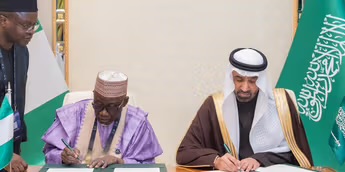
Saudi Arabia and Nigeria have signed their first-ever bilateral agreement on the recruitment of general workers, creating a formal labour corridor between Africa’s largest economy and the Middle East’s biggest labour market.
The agreement establishes a regulated labour recruitment partnership aimed at formalising Nigeria’s contribution to Saudi Arabia’s workforce while strengthening protections for Nigerian workers. It also aligns with Saudi Arabia’s Vision 2030 agenda, which focuses on workforce reform and economic diversification.
Signed on the sidelines of the Global Labour Market Conference 2026 in Riyadh, the deal signals a strategic shift in how Nigerian labour is absorbed into Gulf economies, moving away from informal migration channels toward a state-backed and regulated framework. For Nigeria, the agreement opens up structured employment opportunities at a time of sustained domestic job pressures, while enhancing the economic impact of remittances.
High-level signing at a global labour forum
The agreement was signed by Saudi Arabia’s Minister of Human Resources and Social Development, Eng. Ahmed bin Sulaiman Al-Rajhi, and Nigeria’s Minister of Labour and Employment, Dr. Muhammad Maigari Dingyadi.
A delegate at the conference described the pact as a foundational framework that will govern recruitment processes, worker placement, and labour protections going forward.
What the agreement changes for Nigerian workers
At the heart of the deal is a regulated recruitment system that channels Nigerian workers into Saudi Arabia exclusively through licensed and authorised agencies.
This structure is intended to eliminate informal middlemen, reduce the risk of exploitation, and ensure employment contracts are clear and enforceable. Key employment conditions — including wages, working hours, accommodation, and worker welfare — will now be guided by mutually agreed standards overseen by both governments.
Why Saudi Arabia needs Nigerian labour
Saudi Arabia has increasingly relied on foreign labour to meet rising demand across sectors such as construction, healthcare, hospitality, logistics, and services, particularly as Vision 2030 mega-projects gather pace.
While Asian workers have historically dominated the Saudi labour market, African countries — especially Nigeria — are emerging as important sources of young, trainable labour.
Why the deal matters for Nigeria
For Nigeria, the agreement comes at a critical time. Youth unemployment remains high, while remittances from Nigerians working abroad continue to be a major source of foreign exchange.
By formalising labour migration to Saudi Arabia, the government aims to improve worker protection overseas while maximising the economic benefits associated with foreign employment.
A test case for Africa–Gulf labour partnerships
The deal reflects Saudi Arabia’s broader effort to modernise labour governance, improve compliance, and strengthen worker protections — areas that have attracted international scrutiny in the past.
Riyadh has increasingly positioned labour reform as central to its economic diversification strategy and global competitiveness, making the Nigeria agreement a potential model for future Africa–Gulf labour partnerships.
