

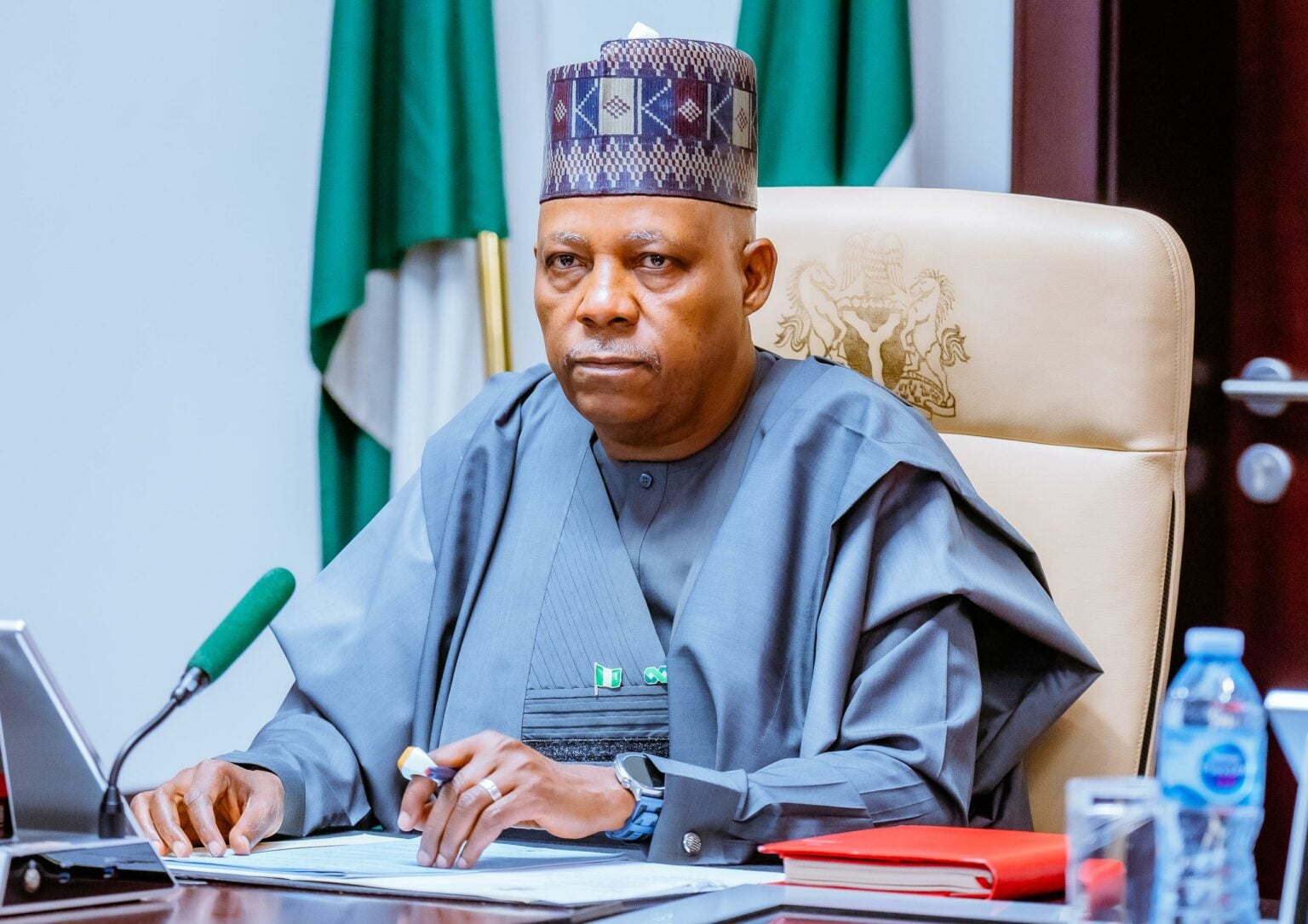
Vice President Kashim Shettima on Wednesday in Abuja said Africa’s development challenges can no longer be financed solely through aid, stressing the urgent need for long-term capital, private sector participation, and investment-driven growth strategies.
Speaking at the Africa Social Impact Summit (ASIS) 2026 High-Level Policy Engagement held at the State House Conference Centre, Abuja, Shettima said development financing must shift toward patient capital, catalytic capital, blended finance, and private enterprise deployed at scale.
The vice president, who was represented by his Technical Adviser on Women, Youth Engagement, and Impact, Hauwa Liman, called for stronger collaboration between government, the private sector, and development partners to accelerate Nigeria’s development agenda.
“Government alone cannot solve Africa’s development challenges,” Shettima said. “For decades, development was framed primarily as expenditure. Our responsibility today is to reframe it as investment — investment in human capital, investment in productive systems, investment in climate resilience, digital infrastructure, and inclusive markets.”
He emphasised that impact investing should not be viewed as charity with a new label, but as a form of strategic capitalism that recognises the link between long-term returns and stable societies.
“Impact investing is not charity with better branding. It is strategic capitalism. It recognises that long-term returns depend on stable societies, educated workforces, healthy populations, resilient communities, and sustainable ecosystems,” he said.
Shettima noted that the most profitable markets of the next generation would be the most inclusive ones, adding that Nigeria is positioning itself to take advantage of this shift by strengthening delivery systems across education, health, social protection, agriculture, climate action, digital public infrastructure, and financial inclusion.
He commended President Bola Tinubu for initiating reforms aimed at repositioning the country’s economy and expanding opportunities for women and young people.
“His Excellency, President Bola Tinubu, has without doubt begun the work of turning the fortunes of this nation around. Yet no government, however committed, can finance or execute this agenda alone,” he said.
The vice president warned against fragmentation in development efforts, urging development partners, civil society organisations, social innovators, and young people across Nigeria and Africa to work together.
“The stakes are too high for fragmentation. Progress demands a coalition. Development is not done to people; it is built with them,” he added.
Shettima described the summit as a platform where commitments must translate into execution, dialogue into decisions, and partnerships into measurable outcomes.
“History will remember us not for the speeches we delivered, but for the systems we build, the institutions we strengthen, and the futures we prepare,” he said.
At the event, Shettima announced the launch of two flagship initiatives — the Business Coalition for Education and the Nigeria Foundational Learning Fund — aimed at accelerating literacy and numeracy while addressing the challenge of out-of-school children.
He also disclosed the launch of the Women and Youth Financial and Economic Inclusion (WYFEI) Nigeria platform, which will serve as the country’s framework for advancing women and youth economic empowerment through co-investment models and performance accountability.
Earlier, the Minister of Budget and Economic Planning, Atiku Bagudu, represented by the Director of International Cooperation, Dr Sampson Ebimaro, said the objectives of ASIS align with the Renewed Hope Agenda of the Tinubu administration, noting that the summit reinforces the need for strong public-private collaboration.
United Nations Resident and Humanitarian Coordinator in Nigeria, Malick Fall, said Nigeria’s commitment to the Sustainable Development Goals remains central to government planning, adding that states must become the primary engines of implementation.
In her remarks, CEO of Sterling One Foundation, Olapeju Ibekwe, said the engagement marked a shift from alignment to cooperation among government institutions, investors, development partners, and civil society, with a focus on execution rather than announcements.
The summit, themed “Scaling Action – Driving Inclusive Growth through Policy and Innovation,” brought together over 200 leaders from government, private enterprise, development institutions, civil society, and the diplomatic community.
Now in its fifth year, the Africa Social Impact Summit continues to drive development dialogue focused on accelerating progress toward the Sustainable Development Goals through innovation, financing, and partnerships.
