

Despite growing resistance across Africa to the expansion of Western military footprints, Somalia and its breakaway region, Somaliland, have both moved to court the United States by offering access to strategic ports and air bases. The parallel overtures underscore intensifying geopolitical competition in the Horn of Africa, a region of mounting strategic importance.
In contrast to several African governments that have scaled back or expelled Western forces in recent years, Mogadishu is signalling a willingness to deepen its military partnership with Washington. Somali authorities have formally proposed renewing an existing military cooperation agreement that would grant the United States access to key Somali ports and airports, reinforcing long-standing security ties.
In 2025, Somalia confirmed it was prepared to grant the U.S. exclusive access to a number of strategically important facilities, according to a letter sent by President Hassan Sheikh Mohamud to then U.S. President Donald Trump. The proposal reportedly included the Balidogle and Berbera air bases, as well as the ports of Berbera and Bosaso.
“These strategically positioned assets provide an opportunity to bolster American engagement in the region, ensuring uninterrupted military and logistical access while preventing external competitors from establishing a presence in this critical corridor,” the letter stated.
Although Washington has not publicly confirmed whether it accepted the 2025 proposal, Somalia’s renewed outreach indicates that the offer remains active as competition for influence around the Red Sea and the Gulf of Aden intensifies.
Reviving a Cold War–era framework
Somalia’s latest proposal is anchored in a 1980 bilateral agreement that already provides a legal framework for U.S. military access. Ali Mohamed Omar Balcad, Somalia’s state minister for foreign affairs, said the government has formally offered to renew the arrangement, describing it as the most “appropriate and lawful channel” for any security cooperation.
According to Bloomberg, Omar Balcad emphasized that the agreement reinforces Somalia’s sovereignty while enabling continued collaboration with Washington amid rising regional competition.
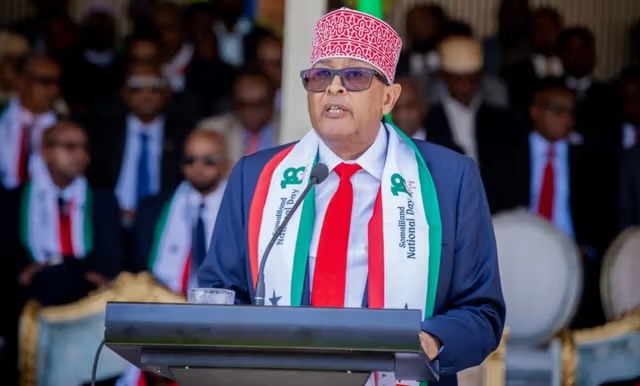
The move is widely viewed as a response to a competing offer from Somaliland, the self-declared republic that broke away from Somalia in 1991 but remains unrecognized internationally. Somaliland has independently proposed granting the United States access to its infrastructure—particularly the strategically located Berbera port and airstrip—in exchange for diplomatic recognition.
Beyond military facilities, Somaliland has also signaled its willingness to provide the U.S. with exclusive access to its mineral resources as part of its bid for international legitimacy. “We are willing to give exclusive access to our minerals to the United States. Also, we are open to offering military bases to the United States,” Khadar Hussein Abdi, Somaliland’s minister of the presidency, told Agence France-Presse.
A complex reality on the ground
While Somalia has formally offered U.S. access to Berbera port, the situation is complicated by the fact that the facility is physically controlled by Somaliland. Day-to-day operations are managed by the Somaliland Ports Authority in partnership with DP World, creating a gap between diplomatic authority and practical control.
As a result, any prospective U.S. military presence would require cooperation not only from Mogadishu but also from Somaliland authorities and the private port operator—highlighting the delicate political and operational balance at play.
Strategic rivalry in the Horn of Africa
The Horn of Africa occupies a pivotal position along maritime routes linking the Red Sea to the Indian Ocean. Its proximity to the Gulf of Aden—through which a significant portion of global trade and energy shipments pass—has long made it a focal point for global powers.
Somaliland’s overtures to Washington have drawn heightened attention amid reports of expanding diplomatic engagement involving Israel, which has shown interest in strengthening its regional presence. While no formal recognition of Somaliland has occurred, speculation surrounding potential partnerships has raised concerns in Mogadishu, which maintains that all foreign military and diplomatic arrangements must be conducted through Somalia’s federal government.
For the United States, the strategic calculus extends beyond diplomacy. Counterterrorism operations, maritime security, Red Sea stability, and access to critical minerals all factor into Washington’s interest. Somalia remains a central partner in operations against al-Shabaab, and access to ports and airfields is essential for sustaining military logistics and operational reach.
By seeking to renew its 1980 agreement with the United States, Somalia is both asserting its sovereignty and attempting to secure Washington’s attention in a region where strategic alignment increasingly carries profound military, diplomatic, and economic consequences.
