

After a six-year pause caused by Covid-19 and security concerns, tens of thousands of fishermen gathered once again in northern Nigeria for the return of the Argungu International Fishing and Cultural Festival, a tradition that blends competition, ritual, and spectacle.
From early morning, participants assembled with nets and gourds in hand, waiting for the signal to begin. As drummers pounded out the age-old rhythms of the Kabawa people, the Sarkin Ruwan—the ceremonial guardian of the river—performed the opening rites, formally clearing the way for the contest to start.
At the signal, fishermen surged forward in a sprint toward the Matan Fada River, which remains closed for most of the year so fish stocks can replenish ahead of the festival. Nets flapped behind them as they plunged into the water, gourds bobbing at their sides to provide buoyancy and a place to store their catch.
The dramatic race into the river marked the climax of four days of celebrations. This year’s event drew national attention, with Bola Tinubu among those in attendance. In parts of the river, the water rose to chest and chin level as fishermen dragged their nets along the riverbed, searching for the biggest prize.
From his canoe, the Sarkin Ruwan watched closely as the competition unfolded. Once the fishermen returned to dry land, their catches were handed to judges, who hoisted enormous fish onto hanging scales amid cheers from the crowd.
The winning catch was a giant croaker weighing 59kg (9st 2lb), earning its captor two brand-new cars and a cash prize of one million naira ($740; £550). Several other massive fish were pulled from the river, but none surpassed the winning haul.
The festival’s origins stretch back more than a century. It was formally established in 1934 to help secure peace between two former rivals: the Kebbi Kingdom and the Sokoto Caliphate. Over time, it has grown into a major cultural event recognised by Unesco, drawing visitors from across Nigeria and neighbouring countries.
Alhaji Hussaini Makwashe, the current Sarkin Ruwan, described Argungu as a place where people come together to share traditions and celebrate the cultural identity of the region. Locals echoed that sentiment, noting that the steady flow of visitors is part of what gives the town its special energy during festival season.
Beyond the fishing itself, the build-up to the main event features a wide range of competitions and performances. Archery contests drew crowds, with lines of competitors crouched on dusty ground, bows at the ready. Traditional music filled the air, with drummers and string musicians providing a constant soundtrack to the celebrations.
One of the most popular attractions was Dambe, an ancient form of boxing in which fighters wrap one hand—the “spear”—in rope and use the other as a “shield” to block blows. The aim is simple: knock down or knock out your opponent. Drone footage captured rings of spectators packed tightly around the fighters.
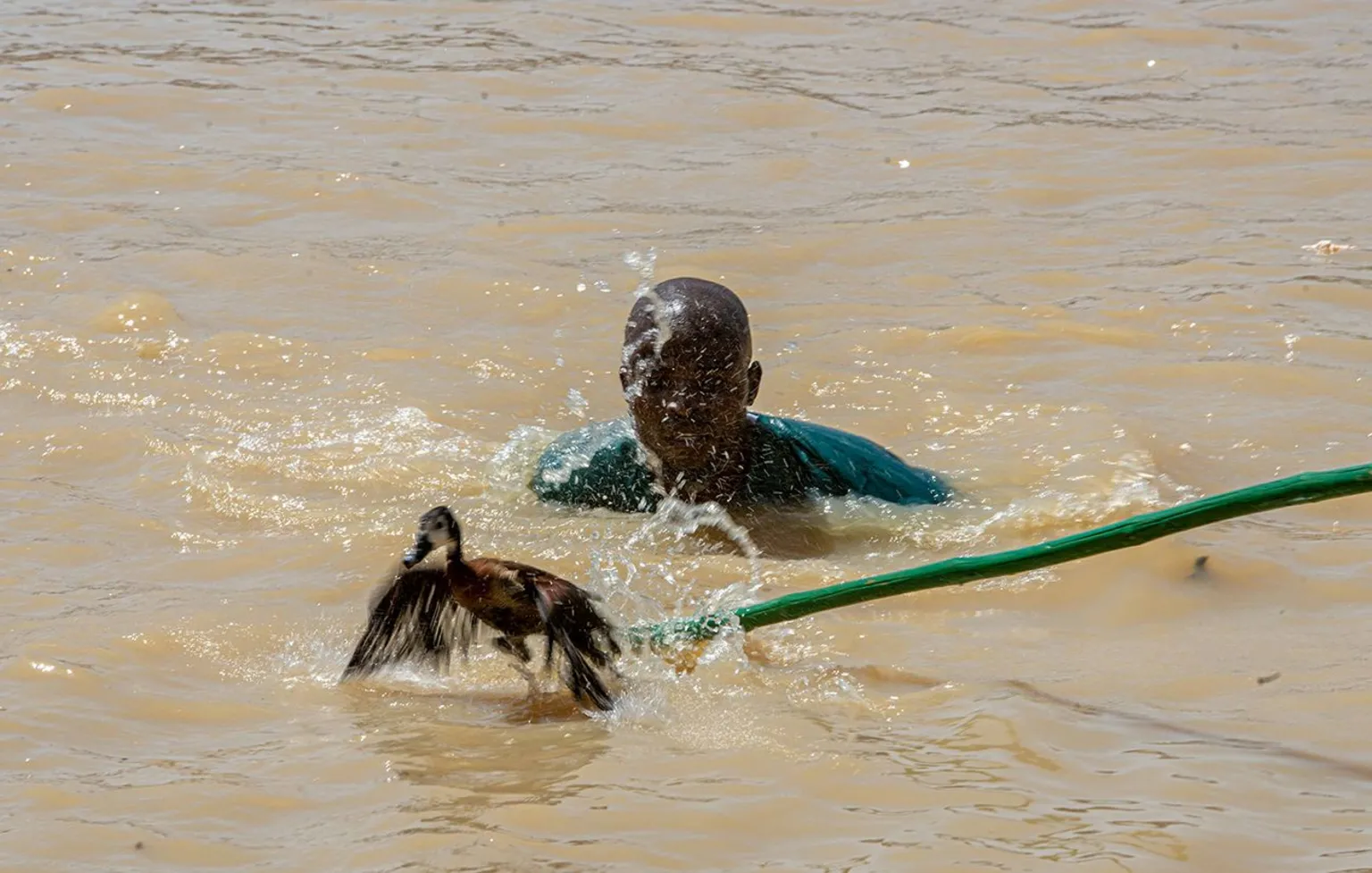
Back on the river, other contests unfolded. Competitors leapt into the water for the wild duck-catching challenge, while younger girls took part in bare-handed fishing events, splashing and laughing as they tried their luck.
With its blend of ritual, sport, music, and community, the Argungu festival once again transformed the riverbanks into a living showcase of northern Nigerian culture—proof that after years of silence, one of the country’s most iconic traditions is firmly back in the water.
