

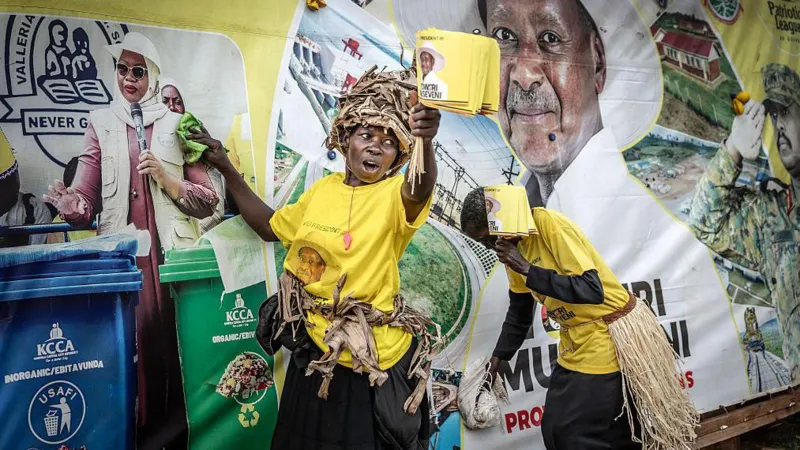
Across Uganda’s campaign trail, youth energy is unmistakable. Whether wrapped in the ruling party’s trademark yellow or clad in the opposition’s revolutionary red, young people dominate rallies, roadside gatherings, and public spaces. They chant, sing party anthems, livestream events on their phones, and form the backbone of election mobilisation.
Their political loyalties may be starkly divided, but the intensity of belief on both sides is strikingly similar.
At a crowded opposition rally in south-western Uganda, Steven Bagasha Byaruhanga voices his hope in challenger Bobi Wine.
“Bobi Wine is a good guy. If he gets to power, I believe he can move this country forward in terms of development. We just need to trust him and allow him to show what he can do,” he tells the BBC.
Standing nearby is Ndyasima Patrick, who supports the ruling establishment. Though he attended the same rally, he remains unconvinced.
“I support President Yoweri Museveni in this election because he has kept us alive all these years,” Patrick says. “He may have ruled for a long time, but we haven’t yet found the right replacement. Bobi Wine looks capable, but this is not his time. Maybe 2031.”
On Thursday, Ugandans head to the polls in a presidential election that mirrors the 2021 contest. President Yoweri Museveni, now 81 and in power for four decades, is once again facing Bobi Wine, the 43-year-old former pop star turned opposition leader whose real name is Robert Kyagulanyi.
The enthusiasm of the campaign underscores a central contradiction: Uganda is one of the youngest countries on earth, with a median age of just 17, yet it remains governed by leaders who came to power decades ago.
For most Ugandans alive today, Museveni is the only president they have ever known.
When Museveni seized power in 1986, Ronald Reagan and Margaret Thatcher were global political heavyweights, Diego Maradona had just lifted the World Cup for Argentina, and Whitney Houston was topping the charts with The Greatest Love of All. Those moments exist only in history books for Uganda’s youth — Museveni, however, remains a constant.
The ruling National Resistance Movement (NRM) is campaigning under the slogan “Protecting the Gains”, arguing that continuity is essential to stability.
“Forty years ago, Uganda was one of the largest exporters of refugees in the region,” says NRM spokesperson Emmanuel Lumala Dombo. “Today, Uganda is Africa’s biggest host of refugees. These are the gains we must protect.”
In contrast, Bobi Wine’s National Unity Platform (NUP) has adopted the slogan “Protest Vote”, framing the election as an urgent call for change.
“This election is about liberation, about freedom, about people reclaiming their voices,” Bobi Wine says, positioning himself as the political expression of youthful frustration.
Both campaigns are targeting the same young electorate — but with sharply different visions of Uganda’s future.
Museveni’s bid for a seventh consecutive term highlights a paradox that extends beyond Uganda. Across Africa, youthful populations are often governed by ageing elites who have skilfully navigated constitutional amendments, term-limit removals, and political pressure to remain in power.
Uganda’s youth bulge represents both opportunity and risk.
Each year, hundreds of thousands of young people enter the job market, yet economic growth has failed to keep pace. Political participation remains tightly managed, and protest is frequently met with arrests, intimidation, or violence — responses that have fuelled resentment rather than silenced it.
Across the region, youth-led unrest has become increasingly visible.
In Kenya, protests driven by young people over governance and economic hardship have rattled the political establishment. In Tanzania, long considered politically subdued, protests following last year’s elections turned deadly. Mozambique has faced violent unrest linked to inequality and unemployment. In Madagascar, youth-led demonstrations last year forced the president to flee, paving the way for military intervention.
Uganda’s authorities are watching these developments closely — determined to avoid similar upheaval.
Against this backdrop, many analysts argue that Thursday’s vote is less about democratic choice and more about managing dissent.
Fergus Kell, a research fellow at Chatham House, describes Uganda’s political environment as “heavily militarised”, saying the ruling party has repeatedly used state institutions to suppress alternative centres of power.
Museveni is widely expected to win.
Uganda’s electoral history, often criticised by observers for falling short of free and fair standards, suggests that an opposition victory remains unlikely.
Last week, the UN Office of the High Commissioner for Human Rights warned that the elections would take place amid “widespread repression and intimidation” targeting opposition figures, journalists, activists, and dissenting voices.
Netherlands-based academic Prof Kristof Titeca argues that while the outward rituals of democracy are being observed, “the outcome is predetermined”.
Some observers note that this election cycle has seen less overt violence than in 2021, when at least 54 people were killed. One explanation may be that the previous vote occurred during the Covid-19 pandemic, when restrictions were enforced more aggressively.
Beyond the two main contenders, several smaller opposition parties are also participating. Long-standing groups such as the Forum for Democratic Change (FDC) and the Democratic Party (DP) continue to field candidates, drawing support from older constituencies, urban professionals, and segments of the middle class.
However, years of internal divisions have weakened their influence. While unlikely to alter the presidential outcome, they remain relevant in parliamentary races and local politics.
For many young voters, though, these traditional opposition parties are seen as relics of an earlier political era — unable to reflect the urgency and confrontational energy driving youth activism today.
Beyond the predictable result, the election raises a deeper question: what comes after Museveni?
Speculation about Museveni’s departure has circulated for more than two decades. Since 2001, elections have been accompanied by repeated constitutional amendments — including the removal of presidential term limits and age limits — that have enabled him to remain in office indefinitely.
“Every time there is talk of transition, it is followed by reforms that allow him to stay,” says political analyst Monday Akol Amazima.
In recent years, the clearest signals of succession have emerged from within the security establishment.
Central to this is Gen Muhoozi Kainerugaba, Museveni’s son, whose rapid rise through the military has transformed abstract succession debates into tangible political realities.
After taking command of Uganda’s land forces in 2021, Gen Kainerugaba’s influence expanded swiftly. By the mid-2020s, he was overseeing the entire military while cultivating a national profile beyond the barracks.
In 2022, he embarked on a nationwide tour of highly choreographed “birthday” celebrations that doubled as political rallies. Shortly afterwards, he launched the Patriotic League of Uganda, widely viewed as a vehicle for future political ambition.
Though he later pledged loyalty to his father’s re-election bid and denied immediate presidential ambitions, his messaging has consistently positioned him as a leader-in-waiting.
In March 2024, Gen Kainerugaba further cemented his authority by initiating sweeping changes within the senior military command — a power historically reserved for the presidency. By restructuring leadership and improving retirement benefits, he consolidated loyalty and neutralised potential resistance.
NRM spokesperson Dombo rejects claims of dynastic succession, insisting the party has formal processes for leadership selection.
“If Gen Muhoozi wishes to pursue political leadership through the NRM, he must follow established procedures,” Dombo says. “Leadership requires proving oneself on many fronts.”
Bobi Wine remains unconvinced.
He compares Museveni’s grip on power to that of Zimbabwe’s former leader Robert Mugabe, who ruled into his 90s before being removed by the military.
“He will not step down,” Bobi Wine says. “He believes this country belongs to him and his family.”
For many young Ugandans, Museveni’s role in overthrowing dictator Idi Amin no longer resonates emotionally. That history carries little weight in a generation grappling with unemployment, inequality, and restricted freedoms.
As a result, the election has come to symbolise more than a contest between two men.
It has become a referendum on whether Uganda will cling to an established order rooted in past achievements — or respond to a generation demanding inclusion, accountability, and meaningful participation in shaping the country’s future.
What is clear is that Uganda’s youth are no longer silent spectators.
