

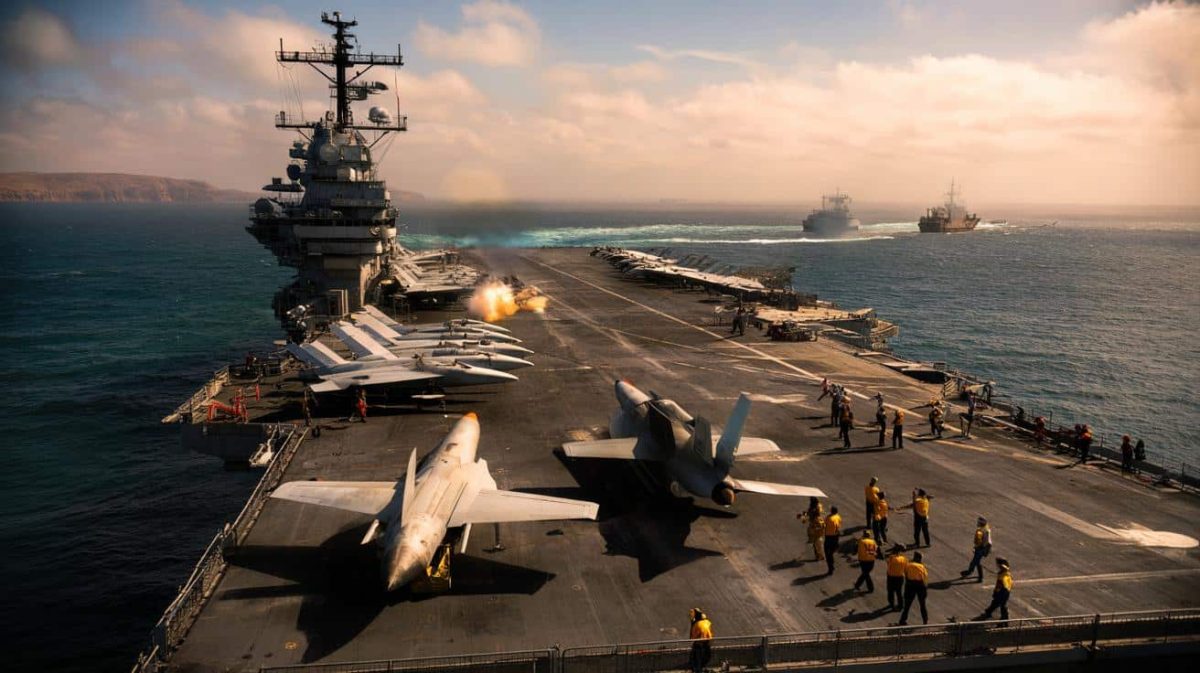
A sharp sea breeze cuts through the smell of jet fuel and hot steel on the deck of the USS Gerald R. Ford. Sailors jog past rows of parked F/A-18 fighter jets, helmets tucked under their arms, casting quick glances at the horizon — and increasingly, at their phones. Back home, families are doing the same, scrolling through news alerts filled with words that sound more like a screenplay than reality: Iran, strikes, ships moving, tensions rising.
Somewhere between Virginia and an increasingly unsettled world, America’s most advanced aircraft carrier is moving steadily across the Atlantic, bound for Europe. Officially, the deployment is routine — a show of support for NATO allies. Unofficially, there’s a shared sense that this mission may not end there. The Ford could soon be positioned much closer to the Middle East.
What the USS
Gerald R. Ford
’s movement signals
When the Pentagon directs the USS Gerald R. Ford toward Europe, the message carries far beyond Washington. This is no ordinary vessel. The 100,000-ton carrier is the U.S. Navy’s newest and most powerful floating airbase, equipped with cutting-edge systems, fighter jets, and early-warning aircraft designed for modern warfare.
Deploying this particular ship sends a clear signal: the United States is watching closely — and it is prepared to act. From Tehran to Moscow, the movement of the Ford is read as a statement of intent as much as a military maneuver.
On paper, the carrier’s deployment supports NATO operations and regional stability, particularly as Europe remains focused on Russia’s war in Ukraine. In practice, timing matters. Iran continues to test long-range drones, proxy forces remain active near U.S. positions, and key shipping lanes from the Mediterranean to the Red Sea are under growing strain.
For many observers, the moment feels tense — the kind of uneasy quiet that often precedes a major shift.
The situation echoes October 2023, when the USS Gerald R. Ford was rushed to the eastern Mediterranean following Hamas’s attacks on Israel. Within days, the carrier and its escort group were positioned offshore, their presence alone delivering a blunt warning. No strikes were needed. The message was unmistakable: escalation would come at a high cost.
There is a familiar pattern. When Washington believes the Middle East risks spiraling into wider conflict, aircraft carriers are moved into place. They were deployed after the killing of Iranian general Qassem Soleimani, after attacks on Gulf oil tankers, and during other flashpoints. The Ford, as the most advanced carrier in the fleet, is typically the one sent when deterrence needs to be unmistakable.
A single carrier strike group can launch dozens of sorties daily, dominate airspace over a crisis zone, and strike targets far inland. For governments across the region, that capability is not theoretical. It shapes decisions, diplomacy, and the calculations made behind closed doors.
That dynamic appears to be at play again. U.S. officials speak in measured terms about “posture,” “deterrence,” and “operational flexibility.” But the underlying message is straightforward: if Iran or its allies escalate further, the USS Gerald R. Ford can be redirected toward the Middle East quickly — and with decisive effect.
