

Senegal’s government has voiced strong disappointment after 18 of its nationals were sentenced to prison in Morocco over disturbances that erupted during the Africa Cup of Nations final earlier this year.
Prime Minister Ousmane Sonko told lawmakers that it was “regrettable” the situation had escalated beyond football, following convictions linked to clashes between Senegalese fans and stadium security in the Moroccan capital.
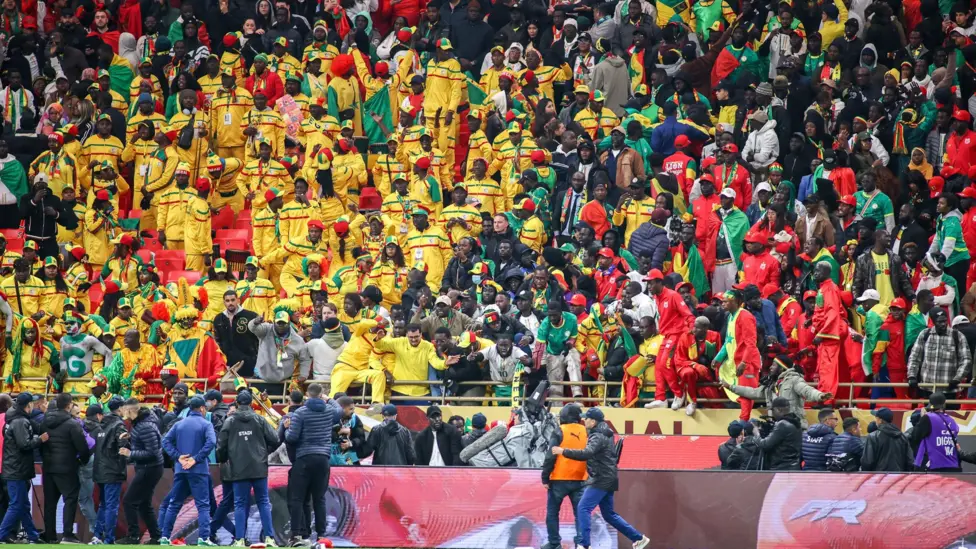
The incidents occurred on 18 January during the final in Rabat, after Morocco were awarded a controversial penalty deep into second-half stoppage time. Tensions flared in the stands, with sections of Senegal’s support attempting to breach the perimeter and enter the pitch.
Security forces intervened as unrest spread, and authorities later accused the detained fans of violence against officials and damage to stadium property.
Flashpoint on the Pitch
The controversial penalty decision also sparked protests on the field. Several Senegal players briefly walked off in objection to the referee’s call before eventually returning to complete the match.
Morocco and Real Madrid forward Brahim Díaz stepped up to take the spot kick, but his effort was saved. Senegal ultimately secured a 1–0 victory after extra time, claiming the continental title.
Prison Sentences and Fines
Last Thursday, a Rabat court handed down custodial sentences ranging from three months to one year to the 18 Senegalese supporters. The court also imposed fines of up to 5,000 Moroccan dirhams (around $545 or £403).
Moroccan prosecutors had pushed for harsher penalties of up to two years’ imprisonment for some defendants, arguing that those involved had “deliberately sought to disrupt the proper conduct of the match”.
All 18 men denied the accusations. According to BBC Afrique, they have chosen not to file an appeal but intend to seek a royal pardon from King Mohammed VI.
Diplomatic Fallout
Addressing Senegal’s parliament, Sonko suggested the episode had strained ties between two countries traditionally regarded as close partners.
“It seems this matter goes beyond the realm of sport and that is regrettable,” he said.
“For two countries that call each other friends, like Morocco and Senegal, things should not have gone this far.”
He added that Senegal’s government had exhausted all available diplomatic channels in trying to secure the release of the imprisoned fans.
Sonko also indicated that Dakar could invoke an existing bilateral agreement allowing the transfer of convicted persons between the two countries, a move that could enable the 18 supporters to serve their sentences back home in Senegal and speed up their return.
Football Authorities React
Senegal’s football governing body, the Senegal Football Federation, said it was deeply troubled by the outcome of the case.
In a statement, the federation expressed “profound dismay and distress” at the rulings. Bacary Cissé, president of the federation’s communications committee, described the punishments as “incomprehensibly harsh”.
As the legal process continues and diplomatic efforts intensify, the case has highlighted how a flashpoint during a high-stakes football final has evolved into a sensitive political and bilateral issue between Senegal and Morocco.
