

The brutal killing of a 14-year-old orphan in Somalia has triggered nationwide outrage and renewed scrutiny of how child abuse is handled in a country where violence inside the home often goes unseen and unpunished.
Saabirin Saylaan was murdered in November by a woman who had been entrusted with her care. The crime, and the disturbing details that later emerged, sparked protests in the central city of Galkayo and intensified demands for stronger child protection measures.
A court convicted 34-year-old Hodan Mohamud Diiriye of murder, sentencing her to death — a rare and severe punishment in cases involving child abuse. Diiriye denied the charges, and her legal team has appealed the verdict.
Her husband, 65-year-old Abdiaziz Nor, was cleared of murder but convicted of negligence. He received a one-year prison sentence and was fined $500 (£375).
A Life Marked by Loss
Saabirin lost both parents before her second birthday. With both grandmothers also deceased, she was raised by her late mother’s aunt, who ensured she attended school and received religious education.
In September, her life changed dramatically when the family agreed to place her with Diiriye’s household to work as domestic help. What followed, according to police, was two months of sustained physical abuse.
Investigators said Saabirin was repeatedly beaten and tortured. Videos and audio recordings retrieved from Diiriye’s phone documented the violence, some of which circulated publicly before the trial. In one recording, Diiriye is heard telling the child, “I’m enjoying your pain.”
A post-mortem examination revealed extensive injuries, including deep stab wounds, indicating prolonged and severe abuse.
Protests and Public Anger
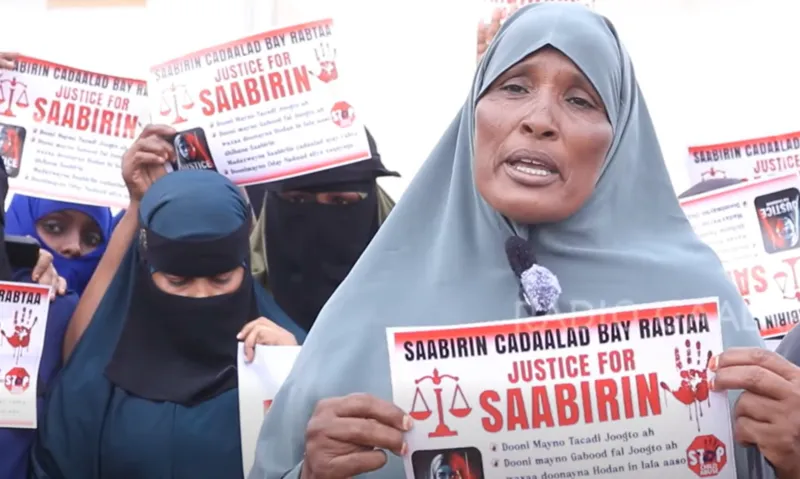
As details of the case became public, anger spilled onto the streets. Hundreds of women and young people marched through Galkayo, carrying placards reading “Justice for Saabirin.” Demonstrators gathered outside the hospital morgue where her body was kept.
One protest turned violent when clashes broke out between demonstrators and police. A young man was shot dead, though it remains unclear who fired the fatal shot.
Online, young women led solidarity campaigns using Saabirin’s name as a rallying cry. In a widely shared video, an 18-year-old protester, Aniiso Abdullahi, said through tears: “No child should ever die like this.”
She and others also rejected attempts by traditional elders to resolve the case through clan mediation — a customary process that prioritises reconciliation and compensation over criminal accountability, often excluding the voices of women and children.
Abuse Hidden Behind Closed Doors
In Somalia, child abuse frequently occurs within extended families, spaces traditionally viewed as private and beyond state intervention. As a result, many cases are never reported.
Authorities livestreamed Diiriye’s trial on social media, a move aimed at reinforcing public trust in the justice system.
Regional police commander Mohamud Abdihakim described the verdict as a milestone. He said the convicted woman now awaits execution and warned that anyone else found complicit would face the full force of the law.
Child rights advocates say the case exposes systemic failures. Najeb Wehelie, director of the child rights group Dhoodaan, said children routinely suffer violence at home and only the most extreme cases ever reach police attention.
Recent incidents underscore the scale of the problem. In June, police in Mogadishu arrested a woman accused of severely abusing her three-year-old stepson. According to Save the Children, at least three major child abuse cases were recorded nationwide in October and November alone, including killings and sexual violence.
Laws Exist — Enforcement Lags
In October, Somalia’s parliament ratified the African Charter on the Rights and Welfare of the Child, which outlines protections against abuse, exploitation, and neglect. The charter mandates criminal penalties for child abuse, state responsibility for orphans, and monitoring systems in schools and hospitals.
However, days later, the ministry of family and human rights development said the charter would be implemented only where it aligns with Islamic law and the constitution. Provisions conflicting with religious teachings — including restrictions on child marriage — would not be enforced.
Women’s and children’s rights activist Fadumo Ahmed argues that even existing laws are poorly enforced. She points to limited police capacity, weak social services, and interference by clan elders as major barriers to justice.
“Many cases are quietly settled between families, and the government is told the issue is resolved,” she said. “Children often don’t even know they are allowed to speak up.”
A Turning Point — Or Another Missed Chance?
Officials in Puntland deny claims of widespread failure, highlighting rehabilitation programmes for vulnerable youth and street children. Still, authorities admit intervention can be difficult when abuse occurs inside households.
“Every child has the right to be removed from a home where they feel unsafe,” said Shukri Ahmed Hussein of Puntland’s ministry of women and family affairs, adding that awareness remains a major challenge.
Saabirin’s death has forced a long-overdue national conversation about child safety. Yet for many, justice remains incomplete.
“There is nothing to celebrate yet,” said young protester Abdikadir Ali in a social media post. “We don’t want justice in words. We want to see it happen — without delays.”
