

France has returned a sacred talking drum looted during the colonial era to Ivory Coast, more than a century after it was taken.
The drum, known as the Djidji Ayôkwé (meaning “Panther Lion”), was seized by French colonial forces in 1916 and later transported to France in 1929. It was displayed for decades in Paris, first at the Trocadéro Museum and later at the Musée du Quai Branly.
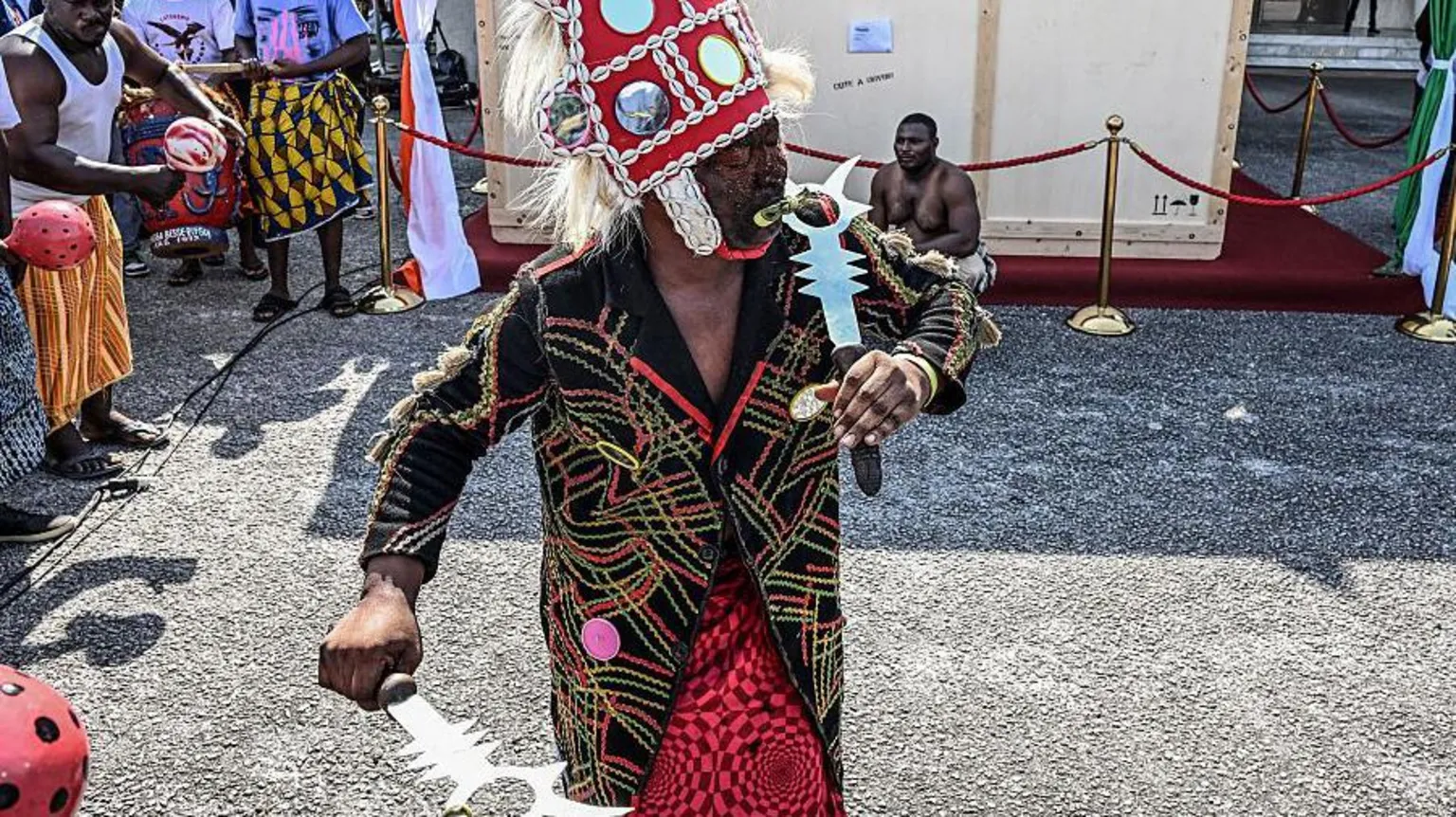
The artefact arrived back in Abidjan aboard a specially chartered plane, where it was welcomed by traditional dancers, local chiefs, and government officials at Abidjan International Airport.
“This is a historic day with a lot of emotions,” said Françoise Remarck, Ivory Coast’s culture minister. She described the return as a moment of justice and remembrance for the country.
The drum belongs to the Ebrié community and holds deep cultural significance. Traditionally, the instrument was used to communicate across villages—warning of danger, calling people to ceremonies, or mobilising communities for war.
The Djidji Ayôkwé is a massive instrument, measuring more than three metres (10 feet) long and weighing around 430kg. It is carved from iroko wood and is considered one of the most important cultural symbols of the Ebrié people.
According to Francis Tagro, director of the Museum of Civilizations, Abidjan, the drum will be displayed in a place of honour at the national museum so younger generations can learn about their cultural heritage.
The return is part of a broader effort by France to repatriate artefacts taken from African countries during colonial rule. The process began in 2017 and has since led to the return of several cultural treasures, including royal artefacts to Benin and a historic sabre to Senegal.
The talking drum is the first item on a list of 148 artefacts that Ivory Coast hopes to recover from museums and collections abroad. Earlier this year, the French parliament passed a special law authorising its return, while the French Senate also adopted a framework law designed to make it easier to remove colonial-era artefacts from national museum collections.
