

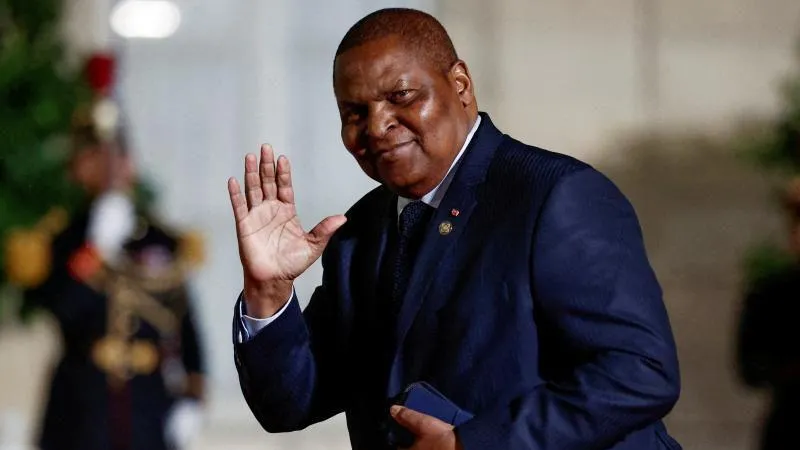
President Faustin-Archange Touadéra of the Central African Republic has secured a third term in office after winning an outright majority in last month’s presidential election, according to provisional results.
The 68-year-old former mathematics professor won 76% of the vote, figures released late on Monday by the country’s election authority show. His victory had been widely anticipated after the main opposition coalition boycotted the poll, arguing that the election process would not be fair.
The general election was held on 28 December, with more than 2.4 million people registered to vote. Observers described the vote as largely peaceful, despite delays caused by late delivery of voting materials and issues with the electoral register.
Touadéra campaigned on his record of improving security in the conflict-prone country, which has faced instability since rebels seized power in 2013. His government has relied on support from Russian mercenaries and Rwandan troops to counter armed groups.
The president has faced criticism since a constitutional change in 2023 removed presidential term limits, allowing him to seek re-election indefinitely.
His nearest rivals, former prime ministers Anicet-Georges Dologuélé and Henri-Marie Dondra, received 15% and 3% of the vote respectively. Both have rejected the results and called for the election to be annulled, alleging widespread fraud and irregularities. The government has denied the accusations.
The Constitutional Court has until 20 January to review any legal challenges and confirm the final results.
Despite its wealth in natural resources such as diamonds, gold and uranium, the Central African Republic remains one of Africa’s poorest and most unstable nations. The United Nations estimates that around half of the population depends on humanitarian assistance.
Analysts say Touadéra’s re-election could further strengthen Russia’s influence in the country, which has received security support in exchange for access to natural resources. The Central African Republic was one of the first African countries where the Wagner Group, a Russian mercenary organisation, became active.
