

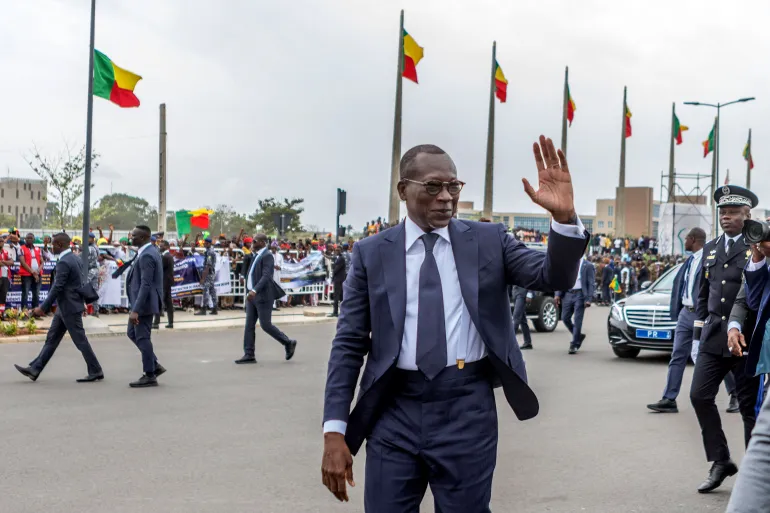
Cotonou, the capital of Benin, is slowly returning to normal after the failed attempt to overthrow the government. The Dantokpa trade centre, one of the largest in the country, is crowded again with traders and people moving through its small lanes, signaling a return to daily life.
Trader Abel Ayihuonsou, among the crowd, observed: For the moment, it is all normal. And that is good for the country, and we are pleased. His relief reflects how the rest of the population reacted to the short-lived but tense crisis on Sunday morning.
Coup Attempt Aborted With Nigerian Backing.
The putsch began when a group of soldiers seized the national television station and declared President Patrice Talon overthrown. The uprising was swiftly subdued by loyalist forces, with the Nigerian Air Force playing a significant role. Nigerian jets struck the mutineers as loyalist troops besieged a military base where the plotters had barricaded themselves, leading them to abandon the TV station and the presidential palace.
By Sunday afternoon, the interior minister had declared that the army had repelled the attempt, and President Talon was on state television vowing to bring to book those behind it. The quick intervention of Nigeria was emphasized by Beninese journalist Moise Dosumou: “A menace of insecurity at its border was certain to over spill on both Nigeria and ECOWAS.
Although the intervention was welcomed by the African Union and ECOWAS, it sparked national debate. Critics questioned why Nigerian fighter jets could stop a coup in another country but not suppress armed groups at home.
Implications in the Region and Future Democracy.
The unsuccessful coup comes as West Africa faces troubled times, with recent military takeovers in Niger, Burkina Faso, Mali, Chad, Guinea, and Guinea-Bissau. Analysts warn that a successful coup in Benin would have helped consolidate the Alliance of Sahel States, a bloc of Niger, Mali, and Burkina Faso suspended by ECOWAS.
Trade was also affected by the attempted putsch. The seaports, especially Cotonou, are important gateways to landlocked neighbors like Niger. Past coup-related interruptions have diverted goods through Mali and Burkina Faso, increasing costs and burdening local trade. He is in his second term and still believes in the democratic process in Benin, under the guidance of ECOWAS, which has helped ensure the functioning of national institutions. But the failed coup has highlighted the lack of confidence among the people, reminding them of how weak democratically ruled countries are. The next presidential elections in April add further doubt about the impact of politics and the timing of the ECOWAS and Nigerian troops in the country to preclude future unrest.
For citizens and local viewers, events in Benin serve as a sharp lesson in how fragile West Africa’s political stability is, with both successful and failed coups continuing to threaten democracy.
