

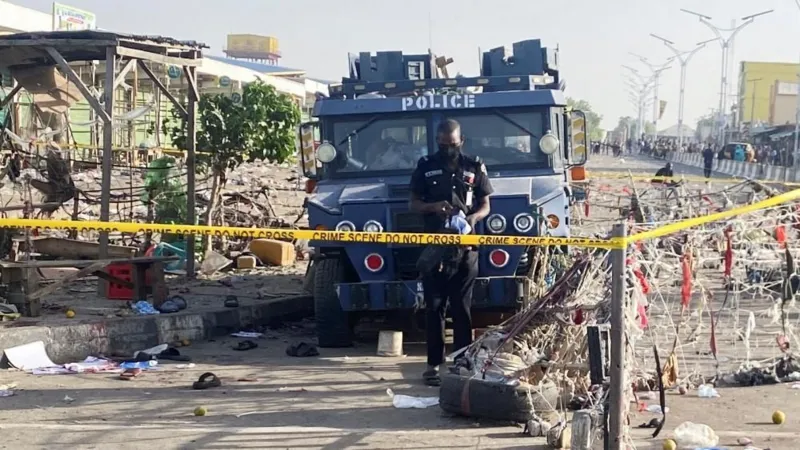
At least 23 people are dead and more than a hundred injured after a series of suspected suicide bombings tore through Maiduguri on Monday evening, in one of the worst attacks the Borno state capital has seen in recent years.
Three locations were hit within minutes of each other at around 7:30pm local time — a post office, a busy weekly market, and the University of Maiduguri Teaching Hospital. All three were packed with people who had just broken their Ramadan fast. Nigeria’s military has blamed the attack on Boko Haram.
Eyewitness accounts paint a chaotic and terrifying scene. Modu Bukar, a resident who was at the market when the first blast went off and helped carry victims to hospital, described the moment the explosion hit. People scattered in every direction, he said, with crowds shouting at each other to keep running. Another resident, Mala Mohammed, 31, described how people fleeing the market instinctively ran toward the post office area — only for a bomber to run directly into the crowd as they tried to escape.
Borno state police confirmed in a statement that preliminary investigations pointed to suicide bombers, and said an inquiry was under way to establish who exactly carried out the attacks.
President Bola Tinubu condemned the bombings on Tuesday, calling them “profoundly upsetting” and the work of “evil-minded terrorist groups.” He said he had ordered security chiefs to travel to Maiduguri and take direct charge of the situation.
The timing of the attack adds a grim layer of context. Just hours before the bombings, security forces had already beaten back an overnight assault by suspected Islamist fighters on a military post on the outskirts of the city. And earlier in the day, there had been a cautious sense among residents that the worst of Boko Haram’s violence was behind them — the group originated in Maiduguri and turned the city into the centre of its insurgency when it launched in 2009, but sustained military operations had pushed fighters into remote border areas in recent years, and the city had been experiencing a relatively calm stretch.
Monday’s attacks, striking deep inside the city at some of its most crowded spots, have shattered that fragile sense of normalcy. While violence has fallen significantly from its peak around 2015, both Boko Haram and the Islamic State West Africa Province have been stepping up attacks in the north-east in recent months. Officials say the threat of further violence remains, and security agencies are now working to reinforce safety across Maiduguri.
