

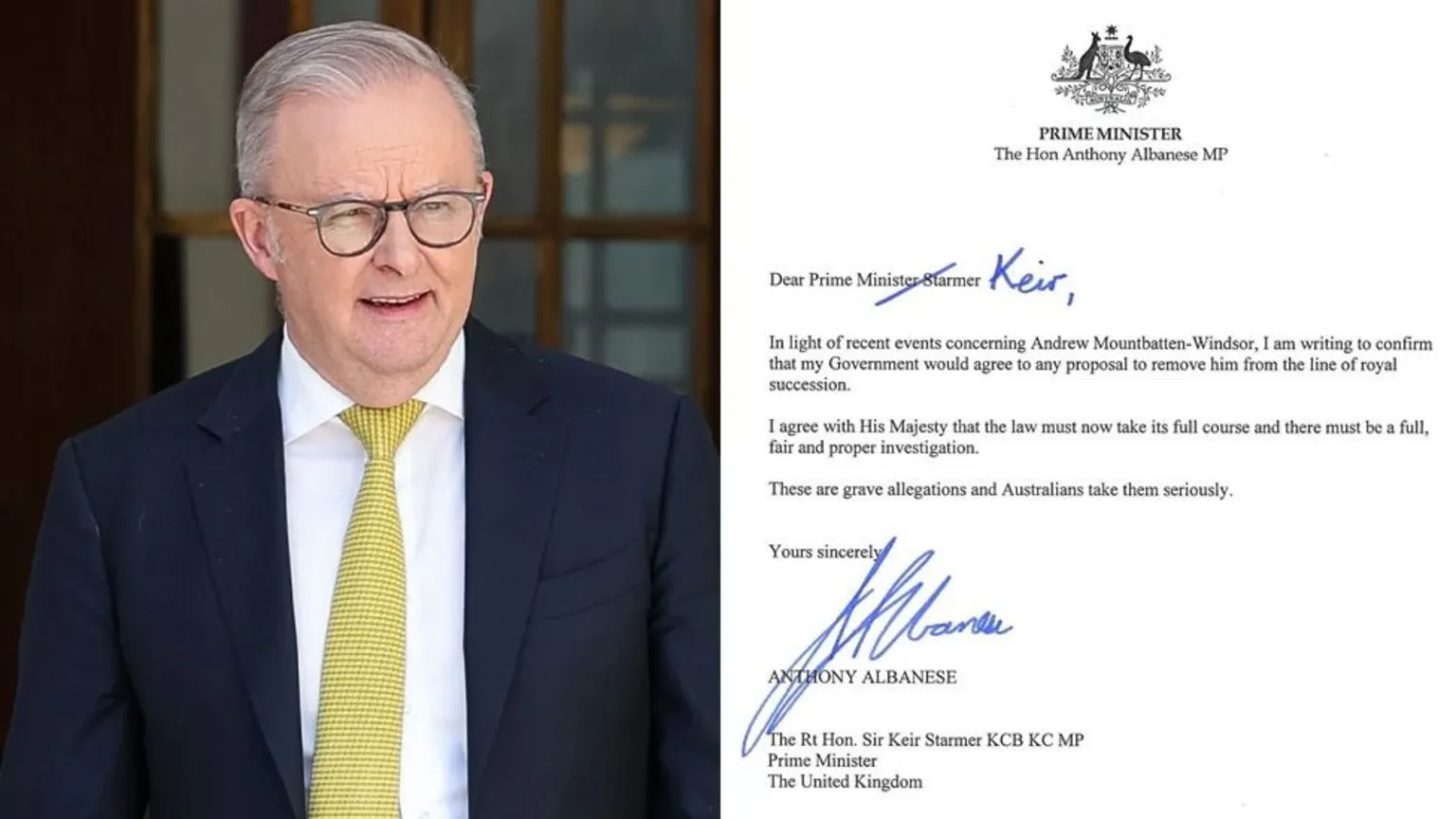
Australia’s prime minister has formally told his UK counterpart that his government would support legislation to remove Andrew Mountbatten-Windsor from the royal line of succession, adding international weight to growing calls for constitutional action following the former prince’s arrest.
In a letter to Keir Starmer, Australian Prime Minister Anthony Albanese confirmed Canberra’s backing for any proposal that would strip Andrew of his place in the succession. Andrew, the younger brother of King Charles III, is currently eighth in line to the throne.
Andrew remains in the line of succession despite having been stripped of his royal titles, including the use of “prince,” in October following mounting pressure over his association with convicted paedophile financier Jeffrey Epstein.
The UK government is now actively considering whether to introduce legislation that would formally remove Andrew from the succession. The discussions follow his arrest on Thursday on suspicion of misconduct in public office. Andrew has consistently and strongly denied all allegations.
Arrest and investigation
Andrew was arrested by Thames Valley Police and released under investigation approximately 11 hours later. The police inquiry remains ongoing.
In his letter, Albanese wrote:
“Dear Prime Minister Starmer, in light of recent events concerning Andrew Mountbatten-Windsor, I am writing to confirm that my government would agree to any proposal to remove him from the line of royal succession.
“I agree with His Majesty that the law must now take its full course and there must be a full, fair and proper investigation.
“These are grave allegations and Australians take them seriously.”
Following his brother’s arrest, King Charles said:
“What now follows is the full, fair and proper process by which this issue is investigated in the appropriate manner and by the appropriate authorities.”
A spokesperson for the UK prime minister confirmed that Albanese’s letter had been received, adding that the government was “considering whether further steps are required in relation to Andrew Mountbatten-Windsor.”
“Given the ongoing police investigation, it would not be appropriate for the government to comment further at this stage,” the spokesperson said.
Parliamentary process and Commonwealth consent
Speaking in Parliament on Monday, Darren Jones said the government was “not ruling out action in respect of the line of succession at this stage.”
Any move to remove Andrew would require an act of Parliament approved by MPs and peers, before receiving royal assent from the King. Because the British monarch is also head of state in 14 Commonwealth realms, the legislation would also need the consent of those countries, including Australia, Canada, Jamaica, and New Zealand.
The most recent precedent for such action dates back to 1936, when Edward VIII and his descendants were removed from the line of succession following his abdication.
Political reactions
Buckingham Palace has not publicly commented on the government’s consideration of legislation.
On Friday, UK Defence Minister Luke Pollard told the BBC that removing Andrew from the line of succession—effectively ensuring he could never become king—was “the right thing to do,” regardless of the eventual outcome of the police investigation.
However, James Murray urged caution, saying that constitutional questions surrounding the succession were “quite complicated” and that the live police investigation needed to “play out.”
Opposition voices have also weighed in. Nigel Farage, leader of Reform UK, said Parliament should not rush to legislate before the police investigation concludes, warning against what he described as a “trial by media.”
As pressure mounts both domestically and across the Commonwealth, the UK government faces a rare and constitutionally sensitive decision—one that could reshape the modern royal succession for the first time in nearly nine decades.
