




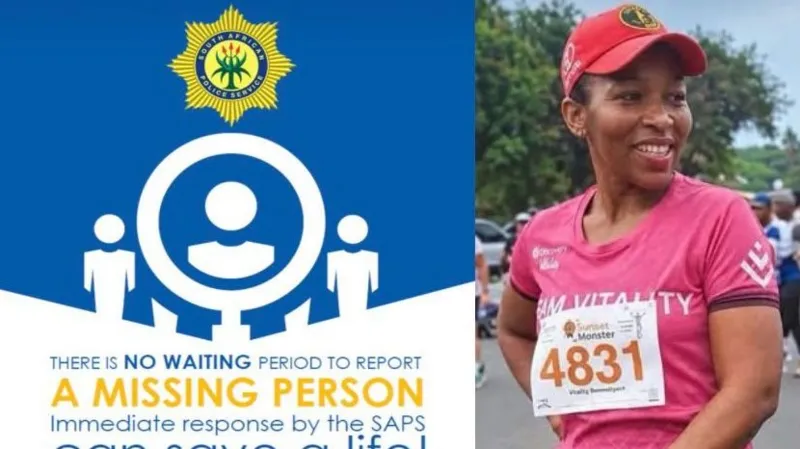
South African police have confirmed the death of a jogger, who went missing during a routine run last week, sparking a nationwide appeal for help finding her.
The body of Elizabeth Moselakgomo was identified by her relatives on Monday after it was discovered east of Johannesburg on Saturday. She is one of five women whose bodies have been found half-naked and bruised in the same area, Kempton Park.
Police said they were not linking the deaths to a serial killer but added that the “similarities are sufficiently concerning… to issue a public warning”.
A jogger who knew Moselakgomo through their running club told the BBC the discovery of the five bodies was “very scary”.
“It’s sad to know that every woman in South Africa… can’t just go outside. You can’t just go to the shop and buy flowers… because you are always in danger,” said Keamo Sefularo.
Police have urged women in the Kempton Park area to avoid walking or running alone “particularly in isolated areas”.
South Africa experiences some of the world’s highest levels of gender-based violence (GBV), with the rate at which women are killed five times higher than the global average, according to UN Women.
Moselakgomo’s body was found on Saturday night, badly bruised and partially clothed.
Just hours earlier on Monday, another woman’s half-naked body was found about 25km (15 miles) away.
The latest discovery was made by a passer-by, who spotted the body on his way to work, police spokesperson Brig Athlenda Mathe told reporters at the scene.
One arrest has been made in connection with the discovery of the first body. The person is still in police custody.
The police have since set up a task team to investigate the murders but these grim discoveries and Moselakgomo’s death have sparked renewed outrage and fear among South Africans.
Tributes poured in for the avid runner, affectionately known as “Tsontso” after police confirmed her death. South Africans also shared the fear and anxiety women often feel in the country.
Lesedi Ledwaba, in a post on X, said: “Women are not free if we have to calculate where, when and with whom we can walk, run or exist safely”.
This was echoed by Sefularo, who said Moselakgomo’s disappearance had been “heavy for the club”.
The 29-year-old also asked whether Moselakgomo would “still be here if maybe she had a small community to run with [or] one or three people”?
“As we always say, when we go out for runs, there’s safety in numbers,” she reflected.
Sefularo shared the measures she often took to keep safe while running, including avoiding taking the same route each day and making sure she ran in areas with good visibility.
Advocacy group Women for Change said the discovery of these bodies was angering.
“What is the purpose of having a protective service like the police if we have to make sure… we are [protecting] ourselves,” the group’s Merlize Jogiat asked.
Jogiat mostly blamed poor implementation of laws passed for the failure to curb the issue and said “pressure in numbers” from citizens could be the solution.
Moselakgomo’s family thanked the public for the support in searching for the mother of one and commended her eight-year-old daughter for raising the alarm about her disappearance.
Authorities are yet to identify the remaining bodies.


