

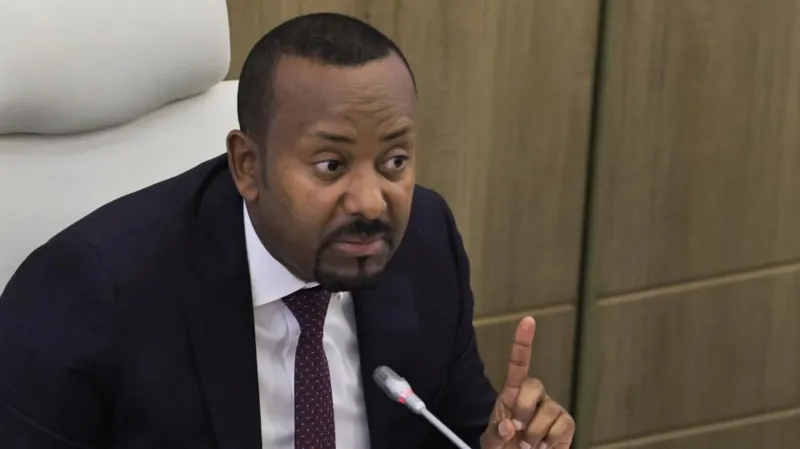
Ethiopia’s Prime Minister Abiy Ahmed has accused Eritrea’s army of committing atrocities during the two-year war in the northern Tigray region, which ended in 2022.
Eritrean forces fought alongside Ethiopian troops against local Tigrayan fighters during the conflict, which centred on control of Tigray, a region bordering Eritrea.
Speaking in parliament, Abiy acknowledged for the first time that Eritrean soldiers had massacred civilians in the historic city of Aksum. Eritrea had previously denied allegations of mass killings reported to have taken place there over two days in November 2020.
The remarks mark another shift in the volatile relationship between the two Horn of Africa neighbours, whose ties have swung repeatedly between cooperation and hostility.
Abiy was awarded the Nobel Peace Prize in 2019 after ending a two-decade military stalemate with Eritrea over a border dispute. Relations strengthened further during the Tigray war, but have since deteriorated amid disagreements over Red Sea access, which landlocked Ethiopia seeks through Eritrea.
Ethiopia’s foreign ministry has also accused Eritrea of changing its stance in Tigray, raising fears of renewed conflict in the region.
The African Union brokered a peace agreement between Ethiopia’s federal government and the Tigray People’s Liberation Front (TPLF) in November 2022, bringing an end to the war. Eritrea was not a signatory to the deal and opposed the ceasefire, arguing it was reached before the TPLF was fully defeated.
All sides to the conflict were accused of abuses, though some of the most serious allegations were levelled against Eritrean troops.
During the war, communications to Tigray were largely cut off and journalists were denied access. However, investigations later pieced together accounts of what happened in Aksum, where witnesses said Eritrean soldiers carried out house-to-house raids, killing hundreds of unarmed civilians—many of them boys and men—on November 28 and 29, 2020.
At the time, Abiy told parliament that “not a single civilian was killed” during the operation. In his latest address, he admitted that mass killings of young people had taken place at the hands of Eritrean troops.
He also said Eritrean forces had demolished homes, looted property, destroyed industries and seized machinery as they took control of cities including Adwa, Aksum, Adigrat and Shire.
Abiy said he had sent envoys to Eritrea during the conflict, urging its leadership to stop the destruction and killings.
His comments came as passenger flights between Addis Ababa and cities in Tigray resumed on Tuesday after a five-day suspension. The flights had been halted following clashes between federal forces and Tigray fighters in a disputed area of western Tigray, fuelling concerns about a return to conflict.
An African Union envoy has estimated that around 600,000 people were killed during the two-year Tigray war.
