

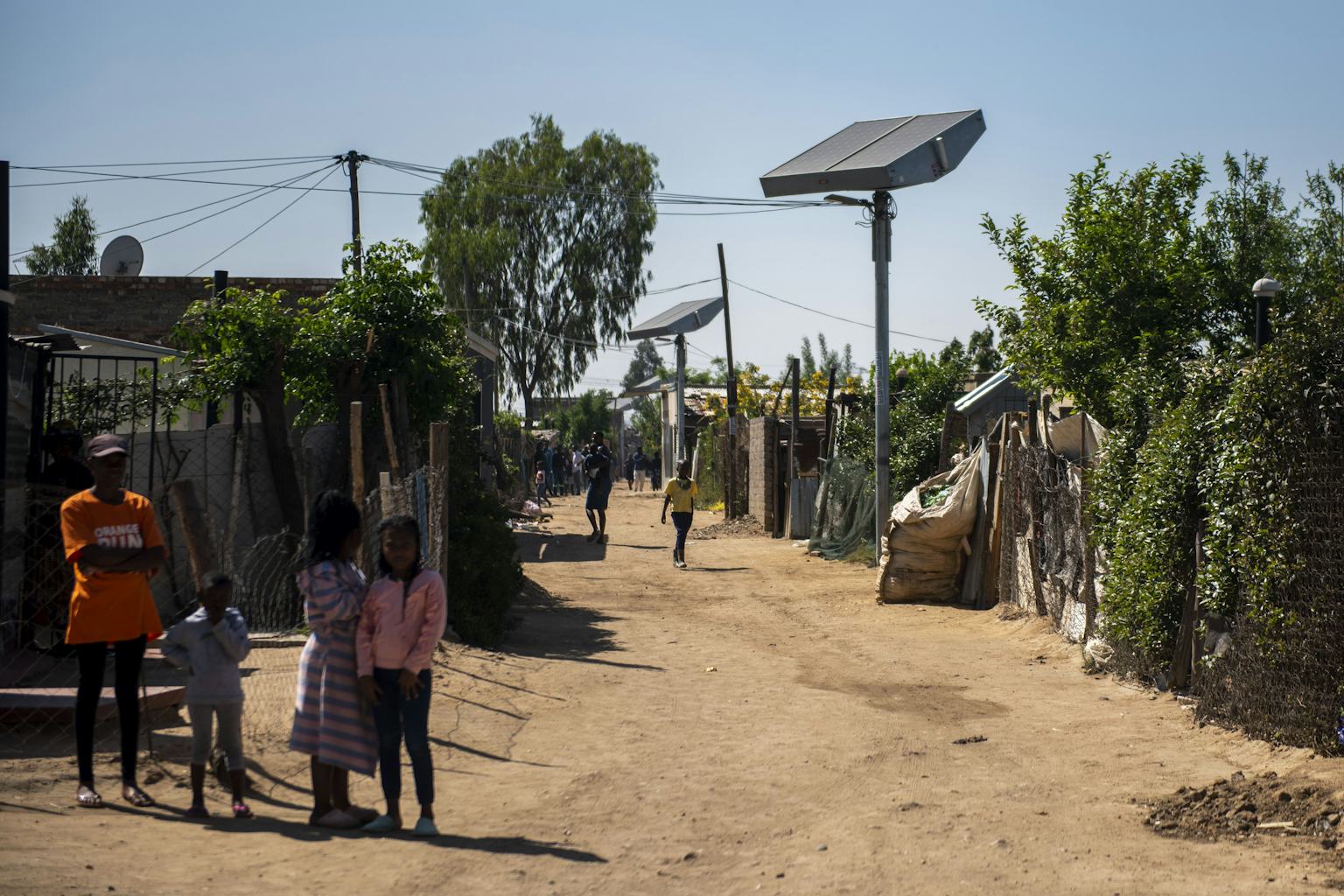
South Africa’s electricity landscape is undergoing a major shift. After years of rolling blackouts that eased in 2024, state-owned power utility Eskom is being broken into smaller entities, while the sector is opening up to private investment. At the same time, households, businesses and municipalities are increasingly finding ways to reduce their reliance on the national grid and turn to renewable energy — a process widely described as off-gridding.
The country has also secured about US$13.7 billion to support its transition away from coal-fired power, with the funds expected to drive renewable energy projects. But amid these changes, large numbers of urban residents who have never been connected to the national grid — particularly those living in informal settlements — remain largely left out of the transition. This gap has drawn attention to the potential role of solar mini-grids.
Off-gridding is often imagined as a complete break from the electricity network, but in reality it takes different forms. Some households and businesses, mainly those with higher incomes, are able to fully disconnect from the grid by installing solar panels with battery storage. Others remain connected to Eskom but supplement their supply with solar systems, generators or batteries to cope with outages and rising tariffs. Meanwhile, millions of people living in informal settlements experience off-gridding in a very different way: through exclusion. Many have no formal grid connection at all, or cannot afford electricity even where it is available, forcing them to rely on unsafe energy sources such as paraffin, candles, firewood or illegal connections.
These different realities show that South Africa’s shift toward decentralised and greener energy is not just a technical change, but a deeply political one. While some households are supported and encouraged to adopt clean energy, others are constrained or ignored, reinforcing long-standing inequalities in cities and infrastructure.
Solar mini-grids have emerged as one possible way to bridge this divide. Typically, a mini-grid consists of solar panels and batteries that supply electricity to a small cluster of homes, often in informal settlements where unemployment is high and individual households cannot afford their own solar systems. These projects are usually developed by small private companies and funded through a mix of grants, aid, research funding and private capital.
In places such as Khayelitsha in Cape Town and Diepsloot in Johannesburg, mini-grids have already been introduced on a limited scale. Surveys of households connected to these systems, as well as those without access, reveal clear patterns. Homes connected to mini-grids are less likely to rely on dangerous fuels or illegal electricity connections. Many residents without access say they would prefer to switch to mini-grids if given the opportunity. Demand is strong, with a large majority of surveyed households expressing interest in being connected.
Affordability, while important, does not appear to be the biggest obstacle. Many households already spend significant amounts on alternative energy sources, including paraffin, gas and informal electricity. The larger challenges lie in funding, regulation and long-term policy certainty.
Private mini-grid providers operate in a fragile environment, facing unclear licensing rules, uncertainty around tariffs and limited access to long-term financing. Municipalities, meanwhile, often lack clear guidance on how alternative energy provision fits into their constitutional responsibility to deliver basic services. Although national policies exist to support alternative energy for low-income households, implementation at local level remains uneven.
Some cities have begun experimenting with mini-grids in informal settlements, but the broader regulatory uncertainty persists. As a result, South Africa’s energy transition risks becoming uneven: wealthier households benefit from incentives such as solar tax rebates and can supplement or leave the grid, while communities that were never fully electrified remain excluded from the shift to clean energy.
If the current trajectory continues, the country faces the prospect of a two-speed energy system — one that delivers clean, decentralised power for some, and continued risk, instability and exclusion for others.
